Amid the rising number of Venezuelans crossing the Darién Gap, the United States sharpened its efforts to contain forced migration in countries like Colombia. Alongside the implementation of extraterritorial asylum mechanisms, the U.S. unilaterally designated Colombia as a 'safe country.' This blog unpacks what 'safety' means in this context. Critical literature on international protection externalisation sheds light on the geopolitics and imbalanced power dynamics that underlie this designation and its implications. It reveals that the U.S. had been seeking to circumvent international protection obligations towards Venezuelans even before the return of Trump-era policies, which escalated anti-migrant rhetoric into mass raids, detentions, and deportations. International aid, cooperation agreements, and shifts in U.S. domestic policy all contribute to enabling this strategy. I argue that 'safety' in the Colombian-US context is not defined by objective conditions but by U.S. interests in migration management. The result is a weakened Colombian capacity to pursue its peacebuilding agenda and prevent further displacement of both nationals and Venezuelans.[1]
Introduction
In 2021, the movement of Venezuelans, together with other forced migrants, soared through the Darién Gap towards the United States (U.S.). This situation prompted the U.S. to adopt diverse strategies to manage migration from South and Central America. In June 2022, the U.S. signed the Los Angeles Declaration on Migration and Protection, along with twenty other countries from the region, including Colombia.[2] The Declaration aimed to foster regional cooperation and establish conditions of safety for people on the move.[3] Implementing the Declaration, the U.S. unilaterally designated Colombia as a 'safe country' for Venezuelan forced migrants before the current Trump administration abruptly repealed the Declaration's cooperation-related commitments and turned to massive deportations. In this blog post, I argue that by labelling Colombia as 'safe,' the U.S. is effectively applying the 'Safe Third Country' (STC) concept in alignment with broader border externalisation practices promoted by countries in the Global North. The blog post is part of a broader research agenda on a decolonial approach to reparative justice for forced migration, with a focus on responsibility-sharing and durable solutions for Venezuelans forced to migrate to Colombia.
The 'safety' classification not only limits access to international protection outside of Colombia—particularly for Venezuelan forced migrants—but also places an unsustainable burden on Colombia's already strained migration and asylum systems. To support this argument, I first examine the definition and implications of the STC concept in international refugee law. Second, I analyse Colombia's emerging role in the U.S. policy of border externalisation. Third, I highlight how, despite the 2016 Havana Peace Agreement[4] and the implementation of certain protection measures for Venezuelan migrants, Colombia continues to function as a country of origin for both nationals and non-nationals who face expulsion. I conclude that the designation of Colombia as an STC has not only led to increased denials of international protection for both Venezuelans and Colombians but also undermines Colombia's negotiating position vis-à-vis the U.S. These dynamics hamper Colombia's ability to resist externalisation pressures and pursue unconditional international cooperation—both for ongoing peacebuilding efforts and for the protection of forcibly displaced Venezuelans.
Safe Third Country definition and implications
At the international level, the Executive Committee of the United Nations High Commissioner for Refugees (UNHCR-EXCOM) has defined the Safe Third Country (STC) concept through soft-law instruments. At the domestic level, nonetheless, States have incorporated this concept into national legislation with a wide margin of discretion. In this section, I assert that the absence of a binding standard regarding the STC concept has enabled States to invoke domestic law in ways that effectively circumvent their international obligations, often with adverse extraterritorial consequences. First, I examine the soft-law standards on the STC concept developed by UNHCR-EXCOM, which serves as an authoritative interpretation of the 1951 Refugee Convention. Second, I engage with critical scholarship that assesses how states in the Global North have implemented the STC concept in practice.
According to the UNHCR-EXCOM Conclusions 15/79[5] and 58/89,[6] and 1993 International Protection Note,[7] States may rely on the concept of 'protection elsewhere' or Safe Third Country (STC) to reject international protection applications under two circumstances: when people forced to migrate have explicitly sought protection from another country, or when people forced to migrate have sojourned and made a regular or irregular 'secondary movement' (transit) from a country whose conditions are considered 'safe' to seek international protection there.[8] In such cases, States must:
- act in good faith (bona fide) when applying this argument and refrain from rejecting asylum applications solely because they could have been submitted in another country;
- provide at least temporary protection for forced migrants, or, alternatively,
- request immediate cooperation from other States to share the protection responsibilities; and
- establish clear and transparent criteria for determining which State is responsible for providing international protection.
The UNHCR–EXCOM further recommends a set of criteria for conducting a case-by-case assessment of international protection applications, namely:
- the nature and duration of the applicant's stay in the third country;
- the individual's intention to seek asylum there;
- the existence of a reasonable connection to the third country, typically based on familial or other meaningful ties; and, most importantly,
- the safety conditions of that country.[9]
Only by applying these criteria can States fulfil their binding non-refoulement obligations and uphold the principle of responsibility-sharing under the 1951 Refugee Convention when relying on the STC concept.[10] Furthermore, in cases where the STC has granted international protection without ensuring a durable solution, such as effective access to education and employment, the State denying protection should, in close cooperation with the UNHCR and other States, adopt measures to secure adequate solutions. This may include creating resettlement pathways within its own territory to comply with the obligations of the 1951 Convention.[11]
Critical scholarship has shown that the STC concept undermines the principle of responsibility-sharing in practice. It reflects and reinforces power asymmetries between States, particularly between the Global North and South.[12] Countries in the Global North often use the STC designation to avoid hosting forcibly displaced persons, shifting responsibilities through a process known as 'externalisation', i.e., the shifting of border controls to other States.[13] This practice, observed in Europe,[14] the Middle East, Oceania,[15] and the Americas,[16] includes deploying migration officials abroad or offering financial incentives to contain migration within the Global South.[17] As a result, international protection obligations are circumvented, and aid is instrumentalised to confine migrants in countries that may also be unsafe.[18] The STC framework has enabled formal and informal externalisation agreements that promote local integration without ensuring resettlement opportunities.
At both domestic and regional levels, States in the Global North and increasingly in the Global South have applied the Safe Third Country (STC) designation in a regressive manner to circumvent international obligations. They often treat even brief transits through third countries as grounds to reject asylum claims, framing such 'secondary movements' as evidence of system abuse by asylum seekers. This rationale has also been used to justify transfers to States that are not signatories to the 1951 Refugee Convention.[19]
Stakeholders should critically examine the STC designation and related 'safety' declarations within the broader context of de facto externalisation and responsibility-shifting. The context includes asymmetric geopolitical relations, domestic migration governance mechanisms, and their uneven impacts on specific groups of forced migrants.[20] Such analysis interrogates the extent to which the STC label genuinely provides international protection. As Liden-Retek observes, when the safety label is employed as an externalisation tool, it undermines individual asylum claims and the rule of law domestically, while also threatening the right to international protection and the agency of entire groups forced to migrate.[21] A multilevel legal analysis[22] is therefore essential to address these dynamics and to prevent SCT frameworks from legitimising opaque and unjust externalisation arrangements that violate the principles of non-refoulement obligation and equitable responsibility-sharing.
The following section examines the context of the U.S.-Colombia international relations in the realm of migration governance. It explores both countries' domestic policies on migration and international protection and analyses their specific impacts on Venezuelan forced migrants. This analysis highlights the adverse consequences of the STC declaration, particularly for those who have stayed in Colombia or moved northwards, as well as for Colombia's efforts to share responsibility and promote international cooperation.[23]
Externalisation evidence in the U.S.-Colombian case
Unlike Turkey[24] and Rwanda,[25] which have formally entered into externalisation agreements with the EU and the UK, respectively, Colombia has not signed such treaties. However, recent foreign policy and legal developments in the U.S. have de facto positioned Colombia in a similar role. The STC designation has reinforced this dynamic. As Salvatore Nicolosi notes, externalisation does not always require binding treaties but may involve diplomatic negotiations concerning border control, extraterritorial asylum processing, and the provision of protection in a third country. These arrangements raise significant accountability concerns.[26] I focus on key developments engaging U.S. externalisation practices.
Since 2019, the U.S. has pursued a strategy of externalising and containing forced migration from countries in the Global South. Initially, it employed cooperative approaches – often referred to as 'soft politics' – to ensure that forced migrants remained within Latin America. This included implementing digital mechanisms to keep asylum seekers outside the U.S. while they awaited decisions on their protection claims. However, in 2025, the U.S. abruptly reversed course, effectively dismantling this arrangement by closing its borders to migrants and initiating widespread expulsions. This section examines the shifts in U.S. foreign and migration policy during this period and explores the negative consequences these changes have had for the region.
The U.S. has publicly signed externalisation agreements only with Canada (2002)[27] and Mexico (2019),[28] both of which apply the STC principle. Under the agreement with Mexico, asylum seekers were unilaterally required to remain while awaiting U.S. hearings. Mexico was later designated as an STC, prompting forced migrants – particularly from Central America[29] - to seek protection. [30] This policy was implemented during the first Trump administration (Trump I, 2017-2021) using tariff pressure.[31]
In other Latin-American countries, externalisation mechanisms have been less explicit. Scholars argue that Global North aid or soft power serves to commodify forced migration in Global South countries, effectively containing migrations.[32] Under Trump I, the U.S. heavily funded Colombia to implement Special Residence Permits (2017-2021) and the Temporary Protection Status for Venezuelans (Decree 216/21). According to the U.S. Congressional Research Service (CRS), 250 million (USD) supported migration regularisation, alongside 697 million (USD) for food security and job creation.[33] Analysis[34] and interviews conducted in 2024-2025[35] indicate that this cooperation is widely understood as part of a broader containment or externalisation strategy, driven by Colombia's strategic position along migration routes to the U.S.
Following Trump I, the Biden government introduced new measures that further restricted the right to seek territorial asylum, including the extended use of Title 42 (initially justified by COVID-19) and the launch of the Customs and Border Protection One App (CBP One app).[36] These policies created bottlenecks in migration flows and placed increased pressure on transit and host countries such as Mexico and Colombia.[37] The CBP One app, introduced in January 2023 by U.S. Customs and Border Protection (CBP) and the Department of Homeland Security (DHS), was presented as a tool to facilitate safe, orderly, and regular migration by scheduling appointments for access to legal migration pathways and international protection. Among various nationalities, Venezuelan nationals were the primary users.[38]
Despite its intended purpose, the CBP has raised concerns regarding racial profiling,[39] suffered from significant technical failures,[40] and contributed to the bottlenecks on the Mexican side of the U.S. southern border, particularly affecting Venezuelan forced migrants who traversed the Darién Gap from Colombia. The Darién Gap, located along the Colombia-Panama border, is a notoriously dangerous migration route, associated with human trafficking, sexual violence, and enforced disappearances.[41] Between 2021 and 2024, approximately one million migrants – over 80% of them Venezuelans – crossed this region (see graph below). For these individuals, as with many others, the CBP One app failed to provide adequate protection.
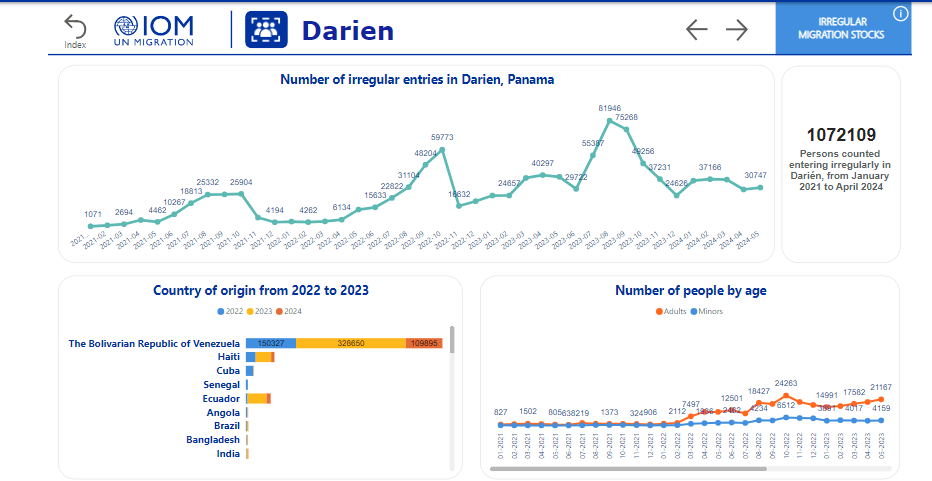
Graph 1. Forced Migrants in transit through the Americas: Darién Gap, IOM 2024.[42]
Together with the CBP One app, the Circumvention of Lawful Pathways resolution of May 2023[43] implemented the 2022 Los Angeles Joint Declaration.[44] This resolution enabled the transfer of international protection responsibilities to Colombia by establishing Safe Mobility Offices (SMOs) in the country. Venezuelans were able to apply for asylum or resettlement in the U.S., Canada, and Spain via these SMOs, provided they remained in Colombia until a decision was made by the U.S. Although the programme had positive outcomes for Venezuelans seeking international protection, its primary aim appeared to be border management, particularly amidst domestic political pressures to limit migration through the southern border.[45]
However, the resolution has also been utilised to deny Venezuelans protection when asylum applications are submitted directly in the U.S.[46] It asserts that Colombia has an operational asylum system and regularisation alternatives,[47] thereby treating Colombia as equivalent to an STC.[48] Consequently, transit through Colombia is deemed a sufficient ground for rejecting asylum applications.[49] As a result, civil society organisations have challenged the legality of the resolution and the CBP One app.[50] The second Trump administration (2025, Trump II) decisively terminated the CBP One app and SMO for asylum or resettlement applications, while also withdrawing the U.S. Agency for International Development (USAID) funding for Colombia's programmes for Venezuelan migrants.[51] Although deportations have been initiated by previous administrations, under Trump II, they escalated not in number but in the scale and intensity of the force used to restrict migration through the southern border. As a result, forced migrants from Venezuela, Colombia, and other countries have been deterred from approaching U.S. borders, as evidenced by the graph below.
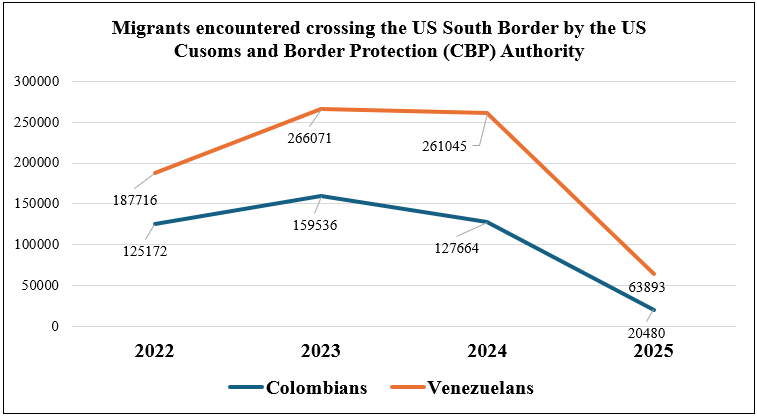
Graph 2. Colombian and Venezuelan migrants, including possible asylum seekers, crossing the U.S. South Border with Mexico (2022- April 2025), author's own elaboration based on the CBP Official Database, Accessed 05.11.2025.
The U.S. government even asked Colombia to receive Venezuelan deportees, considering the country an STC. Nonetheless, the country has refused to accept the Biden and Trump II requests.[52] To date, Colombia has only received its own nationals, while some Venezuelans were sent to Caracas,[53] thereby breaching the non-refoulement obligation.
In the U.S., Venezuelans face significant persecution. The U.S. Immigration and Customs Enforcement (ICE) has conducted systematic raids, large-scale detentions, and deportations of Venezuelans. The U.S. DHS and U.S. Citizenship and Immigration Services have defended these actions by invoking the Alien Enemies Act.[54] They assert that Venezuelans are affiliated with criminal organisations while simultaneously denying them extensions of humanitarian parole and temporary protective status.[55]
The Trump II administration has not only curtailed legal avenues for entry and residence in the U.S. but also compelled Venezuelans, alongside other migrants, to undertake a perilous return through the Darién Gap.[56] As a result, securing a sustainable solution for Venezuelans will be increasingly difficult. While Colombia cannot evade its international obligations to protect Venezuelans, it is erroneous to assume that the country possesses the same resources and capacities as Global North States to do so. Safety can be assured with legal frameworks and institutional capacities that recognise refugee status and provide basic socio-economic rights. Despite Colombia receiving significant resources from the U.S.,[57] the country did not retain installed and enhanced capacities for that purpose, especially at the subnational level.[58] The subsequent section assesses the safety conditions of Colombia, considering the circumstances for both Venezuelans and Colombians.
Colombia, an expulsion country of forced migrants
In 2024, Venezuelan forced migrants topped the UNHCR's ranking of refugee and protection needs, surpassing Syrians, Afghans, and Ukrainians.[59] Nearly 40% reside in Colombia,[60] which has implemented various temporary protection measures, including the 2021 Temporary Protection Statute (TPS).[61] Despite this, Venezuelans report significant gaps in socio-economic security and safety.[62] The TPS was inspired by the Turkish TPS for Syrian refugees.[63] It granted regular status for 10 years to around 2.2 million Venezuelans[64] and enabled them to access health care, education, and employment. However, the cessation of the TPS for new arrivals after May 2023 has raised concerns about local integration.[65] While the Petro administration has introduced new residence permits[66] and special visas, [67] these offer limited protection. Moreover, reliance on international cooperation, alongside the recent withdrawal of USAID funding,[68] has exacerbated the crisis. Stakeholders report that funding will only be available until June 2026.[69]
Colombia's asylum system is widely regarded as outdated and overwhelmed.[70] In ruling SU-543 of 2023, the Colombian Constitutional Court ordered urgent reforms, instructing the Ministry of Foreign Affairs to disapply provisions of Decree 1067/2015, which granted the Ministry excessive discretion and time in refugee determinations. The Court found these provisions violated due process and equality rights in the case of a 90-year-old destitute Venezuelan woman whose asylum and family reunification requests had remained unresolved for over two years, jeopardising her access to healthcare and adequate living conditions. The Court mandated fixed decision timelines, prioritisation based on applicant vulnerability, and consultation with civil society and UNHCR in the redesign of the system.[71] In 2024, the Ministry of Foreign Affairs received 9168 new applications, 95% of which were from Venezuelan nationals.[72]
Venezuelans face heightened risks of violence, including human trafficking, sexual violence, forced displacement, and enforced disappearance, particularly in conflict-affected regions in Colombia. The Darién Gap crisis highlights ongoing challenges to livelihoods and human security, prompting post-pandemic migration of Venezuelans from Colombia to the U.S.[73]
The 2016 Havana Peace Agreement significantly enhanced Colombia's security landscape. Designed to facilitate the reintegration of former combatants of the FARC-EP guerrilla [74] – one of the longest-standing armed actors in the country's prolonged conflict – it established institutional mechanisms to support peacebuilding efforts.[75] Since its implementation, events of internal displacement and massacres registered have declined markedly compared to the peaks of the 1990s and early 2000s. During that earlier period, large-scale displacements contributed to the current figure of 8.9 million Internally Displaced Persons (IDP).[76] Most IDPs remained within Colombia, supported by domestic humanitarian responses[77] and constrained by financial limitations that prevented migration to the Global North. Those who did leave often lacked formal international protection and faced significant challenges in rebuilding their lives abroad.[78] Peace in Colombia remains fragile, with ongoing internal and targeted violence against human rights defenders and former guerrilla fighters.[79] Active hostilities persist, particularly in rural-border regions.[80] The recent mass displacement in Catatumbo, along the Colombian-Venezuelan border, has raised concerns.[81] The Petro administration's efforts to negotiate peace with remaining armed groups, linked to organised crime networks, have largely failed.[82] Consequently, the violent dynamics have changed rather than disappeared. Civilian populations, especially in marginalised urban and rural areas, continue to face displacements, confinements, or armed social control of daily life.[83] In the context of the post-2016 Peace Agreement and ongoing peacebuilding efforts, the 1951 Refugee Convention remains relevant for safeguarding vulnerable populations from persecution.[84] As with Venezuelan asylum seekers, Colombians are forced to migrate and seek international protection.
Conclusion
This blog post analyses the context and implications of the 2023 U.S. designation of Colombia as an STC. The first section examines the UNHCR-EXCOM criteria for STC designation, alongside critical scholarship revealing its externalisation outcomes within an unequal international system. The second section reviews U.S. migration governance over the past decade, demonstrating the use of soft power and coercion to contain migration in countries such as Colombia, particularly impacting Venezuelans forced to migrate. The third section assesses Colombia's safety conditions for both Venezuelans and nationals, concluding that the country remains a country of origin for forced migration. While security in the country has undeniably improved since 2016, Colombia remains far from achieving peacebuilding and ending the forced displacement of nationals and Venezuelans. Both groups continue to face significant risks in both urban and rural peripheries. Thus, the STC category reflects geopolitical power asymmetries rather than actual safety conditions. It serves to circumvent international protection obligations, disguised as legality.
Footnotes
-
Juliana is a PhD researcher at Ulster University, Northern Ireland. Poveda_Clavijo-J@ulster.ac.uk. Some of the sources and reflections referenced in this brief article are drawn from her ongoing research and were presented at the CEISAL Conference in Paris on June 3, 2025. ↑
-
Ninth Summit of the Americas (2022) Los Angeles Declaration on Migration and Protection. Refworld. ↑
-
Ninth Summit of the Americas (2022) Op. cit. p. 4. ↑
-
Colombian National Government and the Revolutionary Armed Forces of Colombia – People’s Army (FARC-EP) (2016) Final Agreement to End the Armed Conflict and build a Stable and Lasting Peace (Havana Peace Agreement), Special Agreement under Article 3 of the 1949 Geneva Conventions that regulate International Humanitarian Law. ↑
-
UNHCR-EXCOM (1979) Conclusion No. 15 (XXX) Refugees without a country of asylum. ↑
-
UNHCR-EXCOM (1989) Conclusion No. 58 (XL) Problem of refugees and asylum-seekers who move in an irregular manner from a country in which they had already found protection. ↑
-
United Nations High Commissioner for Refugees - Executive Committee (UNHCR - EXCOM) (1993) Forty-fourth Session Note on International Protection, Para. 20. ↑
-
Hurwitz, A. (2009) The Collective Responsibility of States to Protect Refugees. First Edition, New York: Oxford University Press, pp. 44-47. ↑
-
Hurwitz, A. (2009), pp. 50-54, referring to the UNHCR-EXCOM Conclusions N° 15 and 58. ↑
-
Article 33, on non-refoulment, and Article 35, on cooperation, basis for the responsibility-sharing principle in the 1951 Geneva Convention Relating to the Status of Refugees and the 1967 Protocol. See: Turk, V. and Garlick, M. (2016). From burdens and responsibilities to opportunities: The comprehensive refugee response framework and a global compact on refugees. International Journal of Refugee Law, 28 (4), 659. ↑
-
Paras. (b), (c) and (d) of UNHCR-EXCOM (1989). ↑
-
Achiume, E.T. (2022) Empire, borders, and refugee responsibility sharing. California Law Review, 110 (3), 1011–40.; Mayblin, L. and Turner, J.B. (2021) Migration studies and colonialism. Cambridge, UK ; Polity Press.; De Genova, N. (2013) ‘We are of the connections’: Migration, methodological nationalism, and ‘militant research’. Postcolonial Studies, 16 (3), 250–58. ↑
-
Refugee Law Initiative (2022) Refugee law initiative declaration on externalisation and asylum. International Journal of Refugee Law, 34 (1), 114–19. ↑
-
Hurwitz, A. (2009), pp. 44-45, 55; Giuffre, M., Denaro, C. and Raach, F. (2022) On ‘safety' and EU externalization of borders: questioning the role of Tunisia as a "safe country of origin" and a "safe third country". European Journal of Migration and Law, 24 (4), 570–99.; Osso, B.N. (2023) Unpacking the Safe Third Country Concept in the European union: Borders, legal spaces, and asylum in the shadow of externalization. International Journal of Refugee Law, 35 (3), 272. ↑
-
Bar-Tuvia, S. (2018) Australian and Israeli agreements for the permanent transfer of refugees: Stretching further the (il)legality and (im)morality of western externalization policies. International Journal of Refugee Law, 30 (3), 474–511. ↑
-
Linden-Retek, P. (2025) “Safe third country”. In: Benhabib, S. and Shachar, A., eds. Lawless Zones, Rightless Subjects: Migration, Asylum, and Shifting Borders. Berkeley: Cambridge University Press, 59–74. ↑
-
Crisp, J. (2022) Unpicking the notion of ‘safe and legal’ routes. Mixed Migration Centre. 6th of December; Crisp, J. (2021) What is Externalization and Why is it a Threat to Refugees? Chatham House. 5 March. ↑
-
Hurwitz, A. (2009), pp. 55, 85-87. ↑
-
Hurwitz, A. (2009), pp. 44-45, 55. ↑
-
De Genova, N. (2013) Op. cit. ↑
-
Linden-Retek, P. (2025) Op. cit. ↑
-
Pijnenburg, A. and Van der Pas, K. (2025) Litigating externalisation policies: The added value of a multi-level legal order? Refugee Survey Quarterly, (hdaf004), 1-25. ↑
-
Socorro Alvarado, L.D. (2023) Hablamos con Fernando García Manosalva, Director de Migración Colombia (Interview with Fernando García Manosalva, Director of the Colombian Migration Authority). Spain: Fundación Carolina. ↑
-
The European Council and Turkey (2016) EU-Turkey Statement & Action Plan.; See also: Osso, B.N. (2023), pp. 289-302. ↑
-
The Government of the United Kingdom of Great Britain and Northern Ireland and the Government of the Republic of Rwanda (2023) Agreement between the Government of the United Kingdom of the Great Britain and Northern Ireland and the Government of the Republic of Rwanda for the Provision of Asylum Partnership to strengthen Shared International Commitments on the Protection of Refugees and Migrants.; See also: UNHCR-UK (2024) UK-Rwanda Asylum Partnership. UNHCR. ↑
-
Nicolosi, S.F. (2024) Externalisation of migration controls: A taxonomy of practices and their implications in International and European Law. Netherlands International Law Review, 71 (1), pp. 4-10. ↑
-
The Government of Canada and the Government of the United States of America (2002) Agreement between the Government of Canada and the Government of the United States of America for cooperation in the examination of refugee status claims from nationals of third countries.; See also: Gil-Bazo, M. (2015) The safe third country concept in international agreements on refugee protection: Assessing State practice. Netherlands Quarterly of Human Rights, 33 (1), 60–4. ↑
-
The United States of America and Mexico (2019) Joint Declaration and Supplementary Agreement
Between the United States of America and Mexico.; See also: Riemer, L. and Fellow R. (2024) Guarding the Gates: The Externalization of U.S. Migration Policies and Their Impact Across the Americas. Externalizing Asylum: A compendium of scientific knowledge. ↑ -
Homeland Security Department and Executive Office for Immigration Review (2019) Asylum Eligibility and Procedural Modifications, Washington D.C. ↑
-
Riemer, L. and Fellow R. (2024). ↑
-
Ortega Velázquez, E. (2020) Mexico as Third Safe Country: Instrumentalization of Right to Asylum. Frontera Norte, 32. ↑
-
Freier, L.F., Micinski, NR & Tsourapas, G. (2021) ‘Refugee commodification: The diffusion of refugee rent-seeking in the Global South,’ Third World Quarterly, vol. 42, no. 11, pp. 2747-2766. ↑
-
Seelke, C.R. (2024) Colombia: Background and U.S. Relations. US Congressional Research Service (CRS). ↑
-
Ceballos Medina, M. (2021) Colombia pa’l norte: entre el “tapón” de las migraciones y la tercerización del refugio (Colombia for 'the North': between 'stopper' of migrations and refugee externalisation). La Silla Vacía. August. ↑
-
Colombian national government officer, interviewed on 16th January and 24th February 2025; Colombian local government officer, interviewed on 22nd January and 26th February 2025; INGO project officer, interviewed on 28th October 2024; INGO project officer, interviewed on 16th December 2024. ↑
-
Collins, P. (2024) Procedural Barriers and the ‘Right to Seek’ Asylum in the Biden Era. Opinio Juris. 23rd August. ↑
-
Ceballos Medina, M. (2022) ¿Ley del embudo? Del tapón del Darién al taponamiento de la frontera norte (The Funnel Law? From the Darien Gap to the Northern Border Blockage). La Silla Vacía. October. ↑
-
U.S. Customs and Border Protection (CBP) (2025) CBP December 2024 Monthly Update. U.S. Customs and Border Protection (CBP). ↑
-
Dávila, S.A., Palacios, A.A. and Thompson, B. (2024) CBP One Mobile Application: Violating Migrants' Rights to Privacy and Freedom from Discrimination and Freedom from Discrimination. University of Illinois Chicago School of Law. [Accessed 05.11.2025]. ↑
-
Stroehlein, A. (2024) An abusive app. Human Rights Watch. ↑
-
Isacson, A. (2024) Migrants in Colombia: between government absence and criminal control. Washington Office on Latin America (WOLA). ↑
-
IOM (2024) Migrants in transit through the Americas: Interactive Dashboard. IOM. ↑
-
U.S. Citizenship and Immigration Services, Department of Homeland Security and Executive Office for Immigration Review, Department of Justice. (2023) Circumvention of Lawful Pathways. ↑
-
Ninth Summit of the Americas (2022) Op. cit. ↑
-
Former US Public Servant, interviewed on 12th September 2025. ↑
-
Seelke, C.R. and Meyer, P.J. (2023) Post-Title 42: U.S. Foreign Policy Initiatives to
Manage Regional Migration.; Seelke, C.R. (2024). Also referred by: INGO project officer, interviewed on 28th October 2024. ↑ -
U.S. Citizenship and Immigration Services, Department of Homeland Security and Executive Office for Immigration Review, Department of Justice. (2023) Circumvention of Lawful Pathways. ↑
-
Gil-Bazo, M. (2015), pp. 60-61. ↑
-
LNGO attorneys in the US, interviewed on 13th March 2025 and 29th August 2025, referring to the considerations of the 2023 Circumvention of Lawful Pathways. ↑
-
Human Rights First, Hope Border Institute, Immigrant Defenders Law Center, Kino Border Initiative, and Refugees International (2024) Brief Amicus Curiae in Support of Plaintiffs in Las Americas Immigrant Advocacy Center, et al., Plaintiffs vs. the Department of Homeland Security, et al., defendants before the United States District Court for the District of Columbia. Human Rights First. [Accessed 05.11.2025]. ↑
-
The White House (2025) Executive Order: Protecting the American People against Invasion; The White House (2025) Executive Order: Reevaluating and Realigning United States Foreign Aid. ↑
-
Colombian national government officer, interviewed on 16th January and 24th February 2025.; Bajonero Váquez, G. (2025) The reason why Colombia is not receiving Venezuelan migrants deported from the US. El Tiempo, Online, 25th February. ↑
-
Buschschlüter, V. (2025) US deportations to Venezuela resume after dispute. BBC News, 24 March. ↑
-
The White House (2025) Executive Order: Invocation of the Alien Enemies Act Regarding the Invasion of The United States by Tren De Aragua. ↑
-
The White House (2025) Executive Order: Securing Our Borders.; Department of Homeland Security and U.S. Citizenship and Immigration Services (2025) Termination of the October 3, 2023, Designation of Venezuela for Temporary Protected Status; US Department of Homeland Security (2025) DHS terminates 2021 designation of Venezuela for temporary protected status [Accessed 04.09.2025]. ↑
-
Canal Laiton, X., Pérez Muñoz, C.E. and Pérez Herrera, P.J. (2025) Migration dynamics and protection risks in north-south return movements in the Americas: Impacts of changes in U.S. migration policy. Mixed Migration Centre; ProLAC. [Accessed 07.06.2025].; Defensoría de los Habitantes de Costa Rica, Defensoría del Pueblo de Panamá and Defensoría del Pueblo de Colombia (2025) Migración Inversa en la Ruta Costa Rica-Panamá-Colombia: Desafíos de Protección y Necesidad de una Respuesta Humanitaria Regional. OHCHR. [Accessed 28.08.2025]. ↑
-
Freier, L.F., Micinski, N.R. and Tsourapas, G. (2021) Op. Cit. ↑
-
INGO project officer, interviewed on 28th October 2024; Venezuelan diaspora NGO member working in Colombia, interviewed on 12th November 2025; LNGO member, interviewed on 14th January 2025; Colombian local government officer, interviewed on 22nd January and 26th February 2025. ↑
-
United Nations High Commissioner for Refugees (2025) Global Trends: Forced Displacement in 2024. UNHCR. [Accessed 05.09.2025]. ↑
-
Inter-Agency Coordination Platform for Refugees and Migrants from Venezuela - R4V Platform (2025) R4V Data Platform. ↑
-
Workshop undertaken with Venezuelan migrants in Colombia, on 15th of January of 2025; See: Inter-Agency Coordination Platform for Refugees and Migrants from Venezuela - R4V Platform (2024) RMNA 2024 - Refugee and Migrant Needs Analysis. R4V Platform. [Accessed 11.05.2025]. ↑
-
Decree 216/2021, Preamble, 9. ↑
-
Colombian Migration Authority (2025) Venezuelan Migrants in Colombia. Colombian Migration Authority [Accessed 05.05.2025]. ↑
-
Guerrero Ble, M. (2023) A forgotten Response and an Uncertain Future: Venezuelans´ Economic Inclusion in Colombia. [Accessed 05.11.2025].; Rojas Silva, N. (2024) La paradoja progresista: medidas regresivas de Petro frente a la migración venezolana. Latinoamérica21, Julio. ↑
-
Decree 1209/2024, Special Residence Permit for legal representatives or guardians of children. ↑
-
Resolution 12509/2024, Special Visitor Visa (Visa V). ↑
-
The White House (2025) Executive Order: Reevaluating and Realigning United States Foreign Aid; Washington Office on Latin America (WOLA) (2025) Trump’s Pause of U.S. Foreign Assistance to Latin America: An “America Last” Policy. WOLA [Accessed 05.11.2025]. ↑
-
Colombian local government officer, interviewed on 22nd January and 26th February 2025; Colombian civil society member, interviewed on 6th August 2025. ↑
-
Moreno, C. and Pelacani, G. (2023) Refugee System in Colombia: The Silent and Prolonged Throes of an Outdated System. In: Vila-Freyer A. and Sirkeci I. eds., Global Atlas of Refugees and Asylum Seekers. London: Transnational Press London, p. 103-114. ↑
-
Colombian Constitutional Court, Decision SU-543 of 2023. ↑
-
Colombian Ministry of Foreign Affairs (2025) Statistics on the Refugee Status Recognition, 2024. ↑
-
Rochlin, J. (2023) Power, mobility, and space: Human security for Venezuelan refugees in Colombia. Journal on Migration and Human Security, 11 (4), 333–355; Isacson, A. (2024) Migrants in Colombia: between government absence and criminal control. Washington Office on Latin America (WOLA) [Accessed Jul 8, 2024]. ↑
-
Revolutionary Armed Forces of Colombia – People’s Army (FARC-EP). ↑
-
Brett, R. (2022) ‘Victim-Centred Peacemaking: The Colombian Experience’, Journal of Intervention and Statebuilding, 16(4), pp. 475–497. ↑
-
Colombian Truth Commission, ed. (2022) Even war has limits: Human rights and international humanitarian law violations and collective responsibilities. Bogotá D.C., pp, 404-436.; Unit for the Attention and Integral Reparation of Victims (UARIV) (2025) Forced displacement - victims according to event type - victims single registry. ↑
-
Sánchez Mojica, &. and Beatriz Eugenia (2009) When rights are the cage: Transplanting rigid soft law for managing forced displacement. Estudios Políticos, 35, 11–32.; Ní Ghráinne, B. (2022) Legal and institutional protection of internally displaced persons. In: Ní Ghráinne, B. Internally Displaced Persons and International Refugee Law. Oxford University Press, 41–87. ↑
-
Nabil Ruprecht, M. (2019) Colombia’s armed conflict and its refugees: International legal protection versus interregional State interests. Colombia Internacional, 100 67–90.; Colombian Truth Commission, ed. (2022a) The truths of exile: The Colombia outside Colombia, summary. Bogotá D.C.: Colombian Truth Commission, pp, 2, 18-20, 22-26. ↑
-
Colombian Truth Commission, ed. (2022); Office of the High Commissioner for Human Rights in Colombia (2025) Annual report of the United Nations High Commissioner for Human Rights and reports of the Office of the High Commissioner and the Secretary-General Situation of human rights in Colombia 2024, A/HRC/58/24..; UN Verification Mission in Colombia (2025) Report of the Secretary-General on the UN Verification Mission in Colombia. S/2025/188. UN Verification Mission in Colombia. ↑
-
International Committee of the Red Cross (ICRC) (2025) Humanitarian Report Colombia 2024. International Committee of the Red Cross (ICRC). ↑
-
Office of the High Commissioner for Human Rights (2025) Colombia: UN experts call for protection of civilians caught up in Catatumbo conflict. Geneva: Office of the High Commissioner for Human Rights. ↑
-
Johnson, K., Botero, F., Botero, M., Aponte, A., and Asprilla, L., (2025) Total Peace Policy: Between light and shadow: A framework to analyse Colombia's comprehensive peacebuilding policy. SOC ACE Research Paper 34. University of Birmingham. ↑
-
Cantor, D. and Miron, S., eds. (2025) Internal displacement in the context of organised criminal violence. Researching Internal Displacement, Refugee Law Initiative, School of Advanced Study, University of London. ↑
-
Querton, C. (2023) Conflict refugees: European union law and practice. Cambridge: Cambridge University Press. ↑